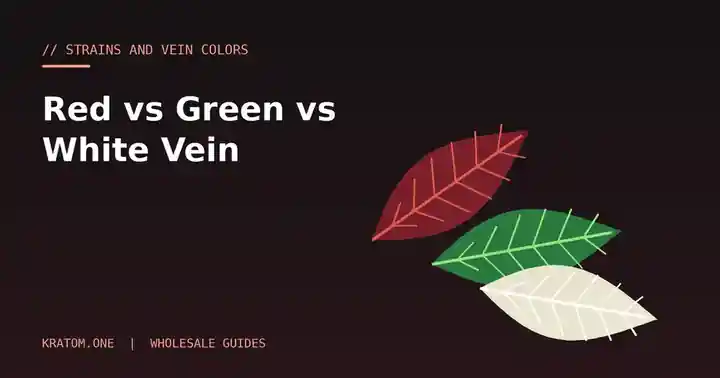
Red, green and white are trade naming conventions that refer to the color of the leaf vein and stem, and the color names are commonly associated with particular processing and drying methods. Strain names such as Maeng Da, Bali, Malay and Borneo are trade names tied to regional or marketing conventions, and they are not standardized across suppliers. For a reseller, that means vein color and strain name are useful ways to organize inventory, but only lot-level lab reports and consistent supplier sourcing tell you what is actually on your shelf.
Key takeaways
- Vein color is a naming and SKU category used across the trade, not a regulated standard.
- Strain names like Maeng Da, Bali, Malay and Borneo vary by supplier, so the same name on two invoices can mean two different products.
- Lot-level lab reports are the only reliable way to tell one batch from another.
- Organize SKUs by form, then vein color, then strain, so staff and buyers can find things quickly.
- Customers often ask by color. Keep your own descriptions factual and avoid making claims.
- Buying from one consistent supplier reduces naming drift between reorders.
What red, green and white vein actually mean in the trade
In wholesale conversations, red vein, green vein and white vein are the three color labels you will see on nearly every price sheet. At the most basic level, the color refers to the color of the veins and stems of the leaf. Over time the trade has also come to associate each color name with certain processing and drying approaches, such as how long leaf is dried and whether it is dried in shade or in other conditions.
Two points matter for a buyer. First, these associations are conventions, not rules. Different producers use the same color words slightly differently, and there is no shared definition you can point to on a purchase order. Second, because the color is a label applied by the seller, it is worth asking the supplier how they apply it and whether that practice stays the same from lot to lot.
Customers frequently ask for products by color. That is a useful fact for planning your range, and it is the only thing you need to take from it. We recommend retailers avoid making claims about what any color or strain does, and keep shelf tags and web listings to plain product facts such as name, form, size and lot information.
Why strain names are not standardized
Maeng Da, Bali, Malay and Borneo are among the most common names on wholesale lists. They are trade names. Some point to a region, some carry marketing history, and some have drifted in meaning as they moved through different supplier networks. One supplier’s Bali may be sourced and processed very differently from another’s, and a third may use the same label for a blend.
This is the practical reason to treat names as a starting point rather than a specification. If you switch suppliers and keep the same SKU name, your customers may notice differences you cannot explain. If you stay with one supplier, you at least have one naming system to learn.
Ask every supplier for a short written description of how they define each name and color they sell, and keep that document with your records. Our guide on how to vet a kratom wholesale supplier covers the wider set of questions worth asking before you commit to a first order.
Why lot-level lab reports matter more than the name
Because color and strain names are not standardized, the label on the bag cannot be your only source of truth. A lot-level lab report ties a specific batch to specific test results. When you receive a new shipment, match the lot number on the packaging to the lot number on the report before you put product on the shelf.
At Kratom.One, batch lab results come with each order, and each powder listing has its own lot testing. Keep those reports on file for every SKU, organized by lot, so you can answer a buyer or auditor quickly. If you are new to reading them, see how to read a kratom lab report.
Consistent sourcing and lot-level documentation work together. The report tells you about a given batch, and a consistent supplier makes it more likely that the next batch is described the same way as the last one.
Vein color at a glance: a SKU reference table
| Vein color | How it is typically used as a naming and SKU category | What to verify |
|---|---|---|
| Red vein | A top-level color category on price sheets, paired with a strain name such as Red Maeng Da or Red Bali. | How the supplier defines the color, and that the lot number on the bag matches the lab report. |
| Green vein | A second top-level category, paired with strain names such as Green Maeng Da or Green Malay. | Whether the supplier’s description of the color and processing stays the same between lots. |
| White vein | A third top-level category, paired with strain names such as White Maeng Da or White Borneo. | Consistency of naming across reorders, plus current lot-level test results. |
| Crushed leaf | Usually listed separately from the color powders, as its own form. | Particle form as described by the supplier, and lot-level results for that listing. |
How to organize SKUs by form, color and strain
A clear SKU structure saves time at the counter, at reorder, and during any audit of your records. A simple approach is to build each SKU name in the same order every time.
- Form first. Powder, capsules, extract, and so on. Each form has its own packaging, storage and labeling needs.
- Vein color second. Red, green or white, written the same way everywhere.
- Strain name third. Maeng Da, Bali, Malay or Borneo, using the supplier’s exact spelling.
- Size and lot field last. Keep a lot number field in your inventory system so each unit links back to its lab report.
For example, a powder SKU might read Powder – Red – Maeng Da – lot number. Use the same pattern for capsules, where the color is the main identifier. Consistency in the SKU name is what lets a new employee find the right bin and the right report without guessing.
Your forms are covered in more detail in the wholesale kratom powder buying guide and the wholesale kratom capsules buying guide.
Building a starter range
A first order does not need to cover every combination. Because customers commonly ask by color, a reasonable starter range gives you at least one option in each of the three vein colors, then adds strain depth where you see repeat requests.
Start narrow, with all three colors present
Kratom.One lists powder in Maeng Da, Bali, Malay and Borneo across red, green and white vein, plus crushed leaf, for seven powder listings in total. Examples on the site include Red Maeng Da, Red Bali, Green Maeng Da, Green Malay, White Maeng Da and White Borneo. You can browse the full set in our kratom powder category. Capsules are offered as unbranded red, green and white vein.
Add depth based on what your customers ask for
Track the names your customers request, and add strains to the range only when you see the same request more than once. A smaller range with accurate records is easier to manage than a wide one with gaps.
Keep documentation current
For each SKU you add, add a folder entry for the lot-level lab report, the supplier’s written definition of the name, and the date received. This takes minutes per SKU and saves hours later.
Consider your own label
If you plan to sell under your own brand, the same naming discipline applies. Decide early whether your label will use color and strain names, and read up on our private label kratom options so your naming matches what your supplier can document.
Compliance and claims
Kratom rules differ by state, county and city, and they change. Do not assume that a product you can stock in one location can be stocked in another. Confirm requirements with qualified counsel in each place you sell, and review our overview of kratom laws for sellers as a starting point only. Kratom.One sells to adults 21 and over on a B2B wholesale basis, reviews ship-to addresses, and does not carry 7-OH products.
On your own shelves and web pages, describe products by name, form, size and lot. Avoid claims of any kind about what a color or strain does.
Frequently asked questions
Is vein color a standardized grade?
No. Red, green and white are naming conventions used across the trade. They are commonly associated with certain processing and drying methods, but the exact meaning varies by supplier. Ask each supplier how they use the terms and get it in writing.
Does the same strain name mean the same product at every supplier?
Not necessarily. Names such as Maeng Da, Bali, Malay and Borneo are trade names tied to regional or marketing conventions. Two suppliers can use the same name for products that are sourced and processed differently, which is why lot-level lab reports and consistent sourcing matter.
How should I answer customers who ask for a specific color?
Tell them which colors and strains you carry and give plain product facts such as form and size. We recommend that retailers avoid making claims about any color or strain, in store, online or on social media.
How many SKUs should a first order include?
There is no single right number. Many retailers start with at least one product in each vein color, then add strains as repeat requests appear. Keep lab reports on file for every lot so the range stays documented as it grows.
Ready to build your range? Kratom.One offers quote-based wholesale pricing with volume tiers, batch lab results with each order and blind-ship packaging. Visit our wholesale page to request a quote.